
Midjourney set the standard for AI image generation. But it has limitations: no official API, Discord-first interface, no free tier. In 2026, dozens of alternatives exist for different needs — whether you want a simple UI, need programmatic access, prefer self-hosting, or want to try multiple models through one platform.
This guide covers 19 tools across four categories. All pricing accurate as of January 2026.
UI-First Platforms
These services have their own web or app interfaces. No coding required. Best for quick generation and iteration.
Midjourney — The Baseline
midjourney.com
The platform that defined AI art. 21M Discord members, ~1.4M paying subscribers, 26.8% market share. What keeps users here: superior photorealism with cinematic lighting, rich textures, and moody atmospheres that feel emotionally resonant. The community-driven Discord approach created an ecosystem where artists inspire each other in real-time — you see what others create, learn from their prompts, iterate together.
The tradeoff? Text rendering remains weak (~30% accuracy). The web app launched alongside Discord, but the interface still lacks the project organization and asset management that web-native competitors offer. But for pure artistic quality and consistent aesthetic across generations, it's still the benchmark others chase.
Key features: V7 model with video generation (5-21 sec clips). Style reference (--sref) and character reference (--cref) for consistency. Omni-reference system. Web app now available alongside Discord.
Best for: Artistic quality, community feedback, consistent aesthetic across projects.
Leonardo AI
leonardo.ai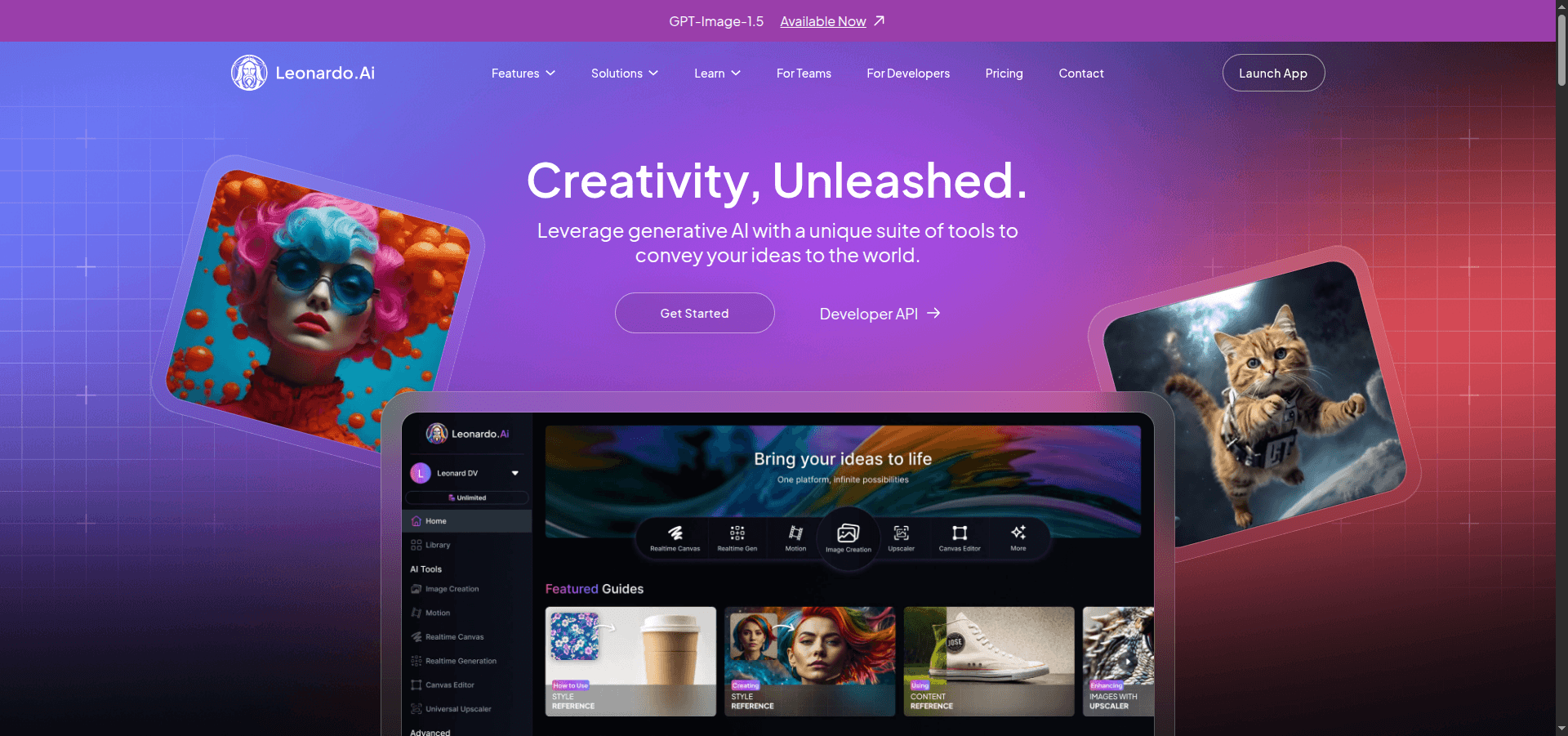
18M+ creators use Leonardo for game assets and concept art. What sets it apart: granular control over every aspect of generation. The Image Guidance suite offers six reference types (Style, Content, Character, Pose, Depth, Edge) — upload a reference and the model respects it. Multiple base models (Phoenix for photorealism, Anime XL for stylized work) with adjustable parameters. Image-to-image workflows with strength sliders. Style LoRAs (Elements) with tunable influence. This depth of customization gives control that Midjourney's simpler interface doesn't offer.
Users love the balance between automation and creative authority. You maintain your unique voice through robust customization rather than surrendering control to the algorithm. The real-time Canvas with inpaint/outpaint means less post-production work in external editors.
Key features: Flow State real-time generation. Image Guidance suite with 6 reference types. Real-time Canvas with inpaint/outpaint. Motion 2.0 for video. Phoenix model for quality. Elements (style LoRAs with adjustable strength).
Best for: Game developers, concept artists, anyone who needs character consistency across multiple generations.
API: REST API. SDK: Python, TypeScript. MCP. CDN hosting. Upscaling, inpainting, outpainting, background removal.
Adobe Firefly
firefly.adobe.com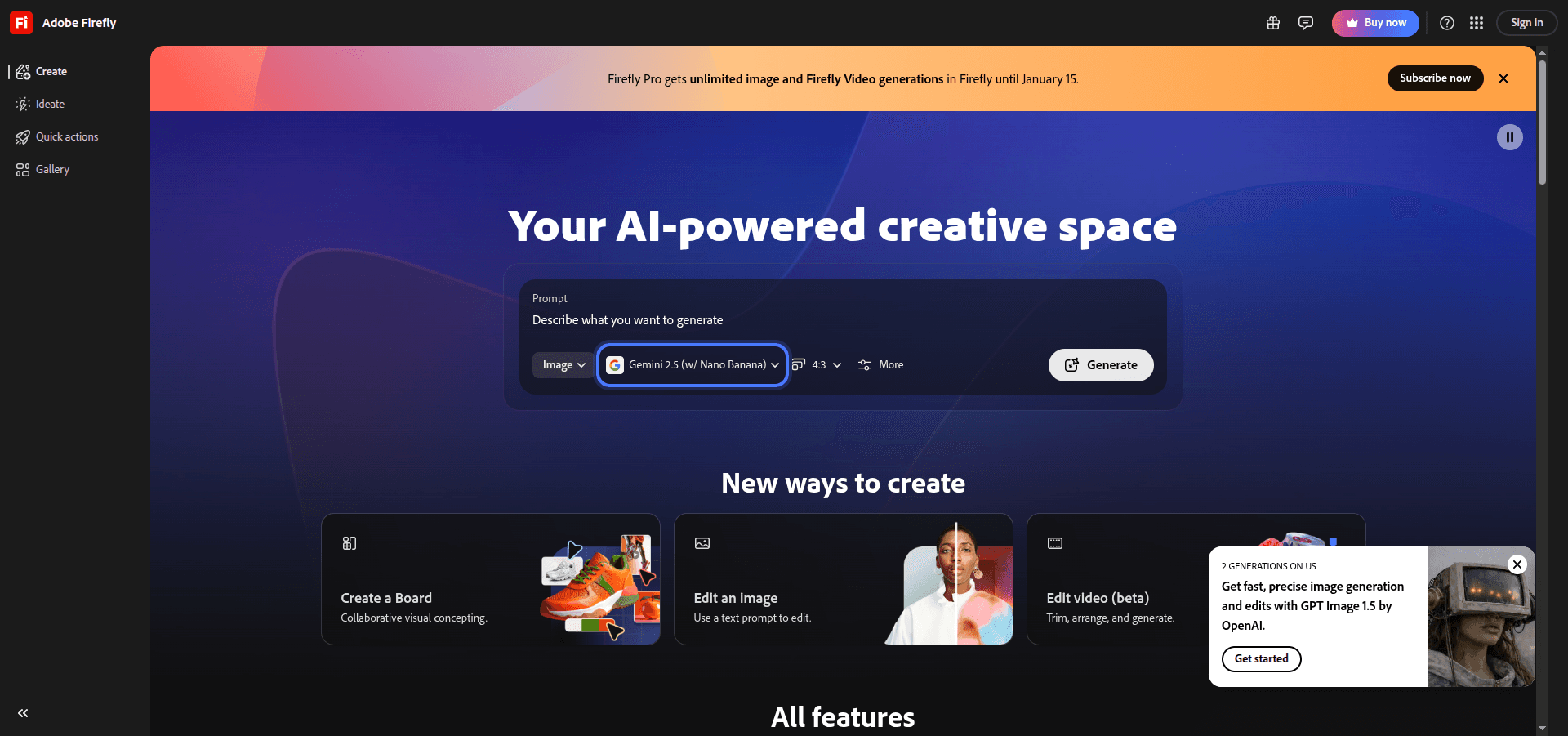
The enterprise-safe option. Firefly is trained only on Adobe Stock, public domain, and licensed content — no scraped web data. This matters for commercial work: IP indemnification on qualifying plans means legal protection if copyright questions arise.
Firefly 5 generates photorealistic images at native 4MP resolution with strong anatomical accuracy. The Prompt to Edit feature lets you describe changes in natural language — "move the tree," "swap the sky" — and watch them happen instantly. Content Credentials (C2PA standard) prove AI origin on every image, increasingly important as AI detection becomes standard in publishing.
For Creative Cloud users, the deep integration with Photoshop and Illustrator eliminates the export-import dance between generation and editing tools.
Key features: Firefly 5 model (4MP native resolution). Content Credentials on all images (C2PA standard proving AI origin). Partner models include FLUX.2, Gemini, GPT. Deep integration with Photoshop, Illustrator, and Creative Cloud. Style Kits for brand consistency. Prompt to Edit natural language editing.
Best for: Commercial projects where copyright matters. Adobe users who want generation inside their existing workflow.
API: REST API. SDK: JavaScript. MCP. S3+CloudFront CDN (temporary URLs). Generative fill, generative expand, background removal, upscaling.
ChatGPT / GPT-4o
chatgpt.com
GPT-4o generates images natively inside ChatGPT — the same interface millions already use daily. No separate app, no new subscription, no context switch. Need a quick mockup while discussing a project? Generate it mid-conversation. The fundamental difference: conversational iteration. "Make the sky darker" works exactly as you'd expect, and the model maintains context across edits. Where other tools require re-prompting from scratch, GPT-4o remembers what you're building.
The breakthrough is text rendering. Earlier models mangled typography; GPT-4o handles it cleanly — readable signs, labels, captions within images. Anatomical accuracy (hands, faces) has improved dramatically. The tradeoff is speed: ~1 minute per generation vs seconds on dedicated platforms.
Over 700 million images generated in a single week shows the adoption curve. For users already paying for ChatGPT Plus, it's image generation without another subscription.
Key features: Best-in-class text rendering in images. Strong anatomical accuracy (hands, faces). Conversational editing with context preservation. C2PA metadata for provenance. Multi-turn generation maintaining character consistency.
Best for: Iterative refinement through conversation. Images with readable text. Users who already pay for ChatGPT Plus.
API: REST API (DALL-E 3). SDK: Python, TypeScript. Temporary CDN URLs. Basic transformation: variations, editing via masks.
Ideogram
ideogram.ai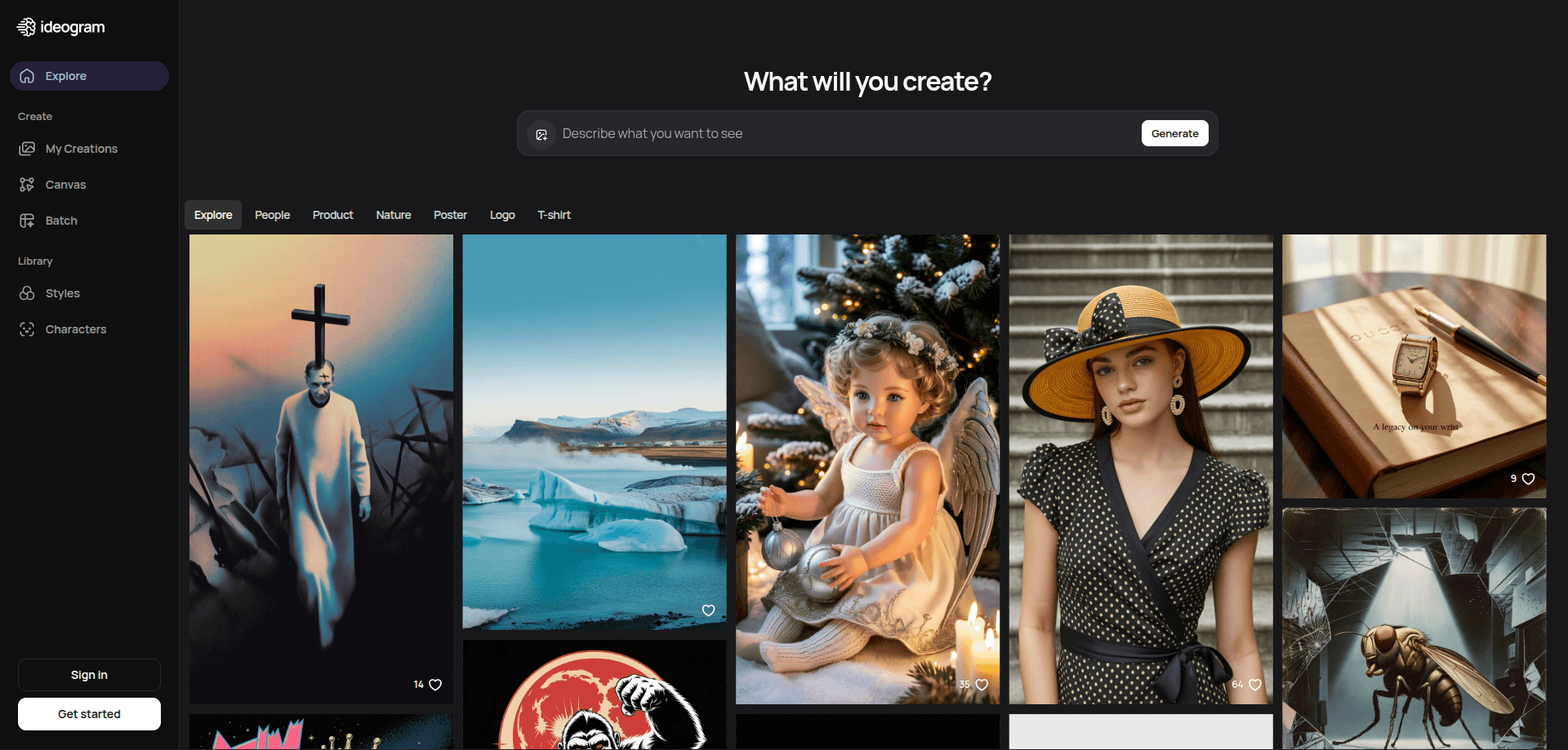
Founded by former Google Brain researchers specifically to solve typography in AI images. Where Midjourney achieves roughly 30% text accuracy, Ideogram hits ~90%. This isn't incremental improvement — it's a different category of capability.
The Style Reference system lets you upload up to 3 reference images to replicate colors, textures, and mood. Random Styles accesses 4.3 billion+ combinations for inspiration. Savable Style Codes store exact visual styles for reuse — critical for brand consistency across campaigns.
For logos, branding, marketing materials — anything where text needs to be readable — Ideogram delivers production-ready results from the first attempt. Less time fixing text errors in Photoshop.
Key features: Ideogram 3.0 model with industry-leading text rendering. Style Reference (up to 3 images). 4.3B+ Random Style combinations. Savable Style Codes. Magic Fill and Extend editing. Multiple style modes: Realistic, Design, 3D, Anime.
Best for: Logos, branding, marketing materials — anything where text needs to be readable.
API: REST API. Temporary image URLs (expiring). Edit, remix, reframe, upscale, background replacement.
Google Gemini / Imagen
gemini.google.com
Google's image generation spans multiple products. Gemini 2.5 Flash Image (nicknamed "Nano Banana") became popular in 2025 for a specific reason: multi-image fusion. Upload multiple images, describe how to combine them, and the model merges elements coherently. Restoring rooms with new color schemes, combining product shots into lifestyle scenes — use cases that required Photoshop skills now work through natural language.
Character consistency across generations — historically difficult in AI synthesis — works reliably. The semantic understanding from Gemini's world knowledge means the model grasps context, not just visual patterns. Strong text rendering, especially on the Pro model.
For Google ecosystem users, the integration across Gemini app, Google Photos, and developer APIs creates a seamless workflow.
Models: Gemini 2.5 Flash Image (speed-optimized), Gemini 3 Pro Image (quality-optimized), Imagen 3/4 (enterprise via Vertex AI).
Key features: Multi-image fusion. Character and style consistency across edits. Search-grounded generation (Pro model). Strong text rendering. SynthID invisible watermarks. Natural language editing.
Best for: Google ecosystem users. Developers who want conversational editing with API access. Multi-image composition workflows.
API: REST API. SDK: Python, JavaScript, Go, Java, C#. CLI: gemini-cli. Base64 response (no hosting). Inpainting, outpainting, upscaling, subject customization.
Recraft AI
recraft.ai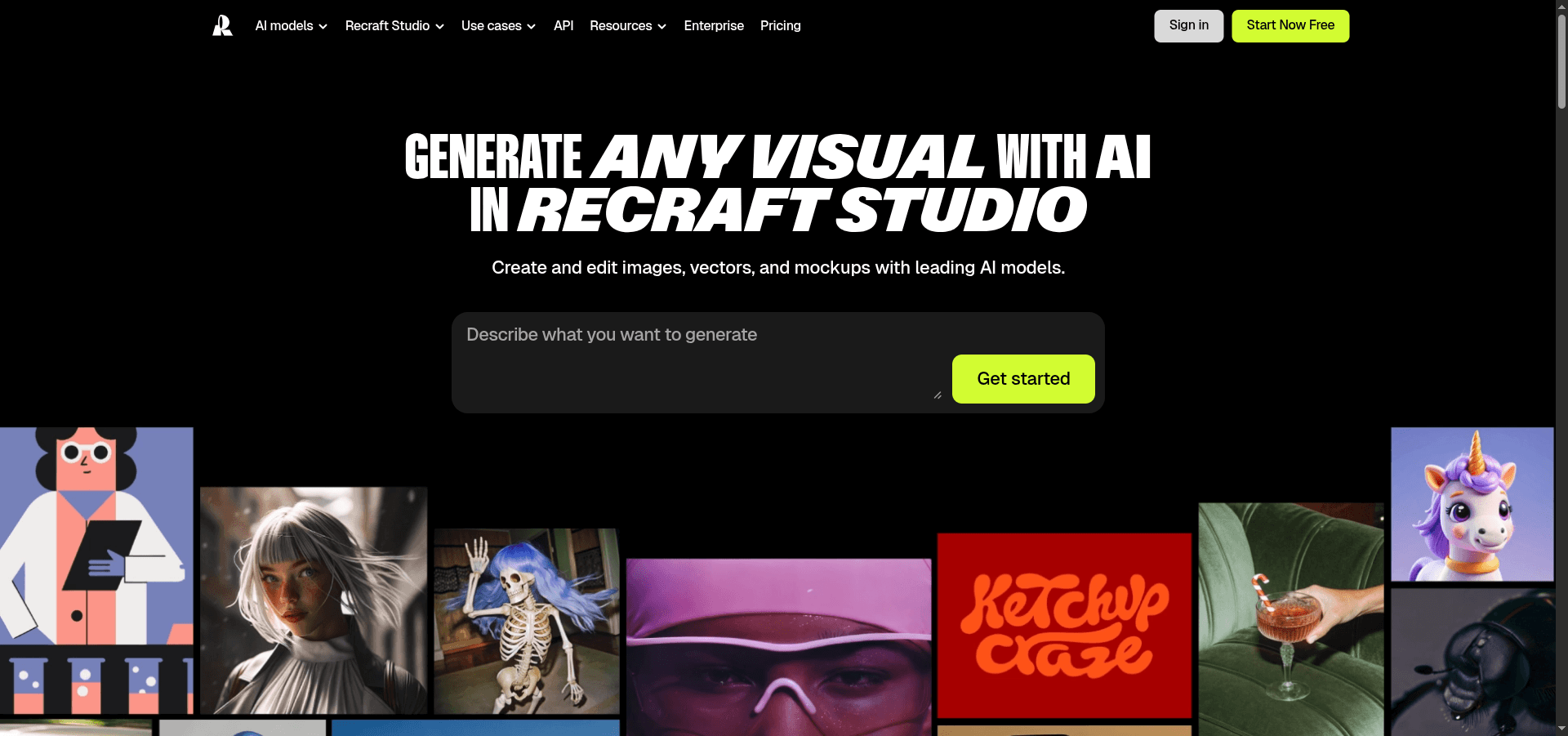
One of only two AI tools with native SVG vector output (the other being Adobe Firefly). 4M+ users, mostly designers. The difference matters: vectors scale infinitely without quality loss. A logo generated here works on business cards and billboards without creating multiple file versions.
The Recraft-20B SVG model understands design principles, not just visual patterns — clean vector paths that require minimal touch-up work. Generated SVGs open directly in Illustrator and Figma for refinement. According to Google's Web Performance research, SVG icons load 73% faster than equivalent PNGs and use 85% less bandwidth.
Precise color control through hex codes means brand palettes stay consistent across generated assets. For icon sets, patterns, and anything that needs infinite scalability — there's no real alternative.
Key features: True vector generation — export actual SVG files, not rasterized images. V3 model with strong prompt adherence. Pattern generation. Product mockups. Brand consistency tools with hex color control. Accurate text rendering. AI vectorizer converts existing PNGs/JPGs to SVG.
Best for: Logo design, icon sets, patterns, anything that needs to scale infinitely.
API: REST API (OpenAI-compatible). Temporary image URLs. Vectorization, upscaling, inpainting, outpainting, background removal.
Reve AI
reve.ai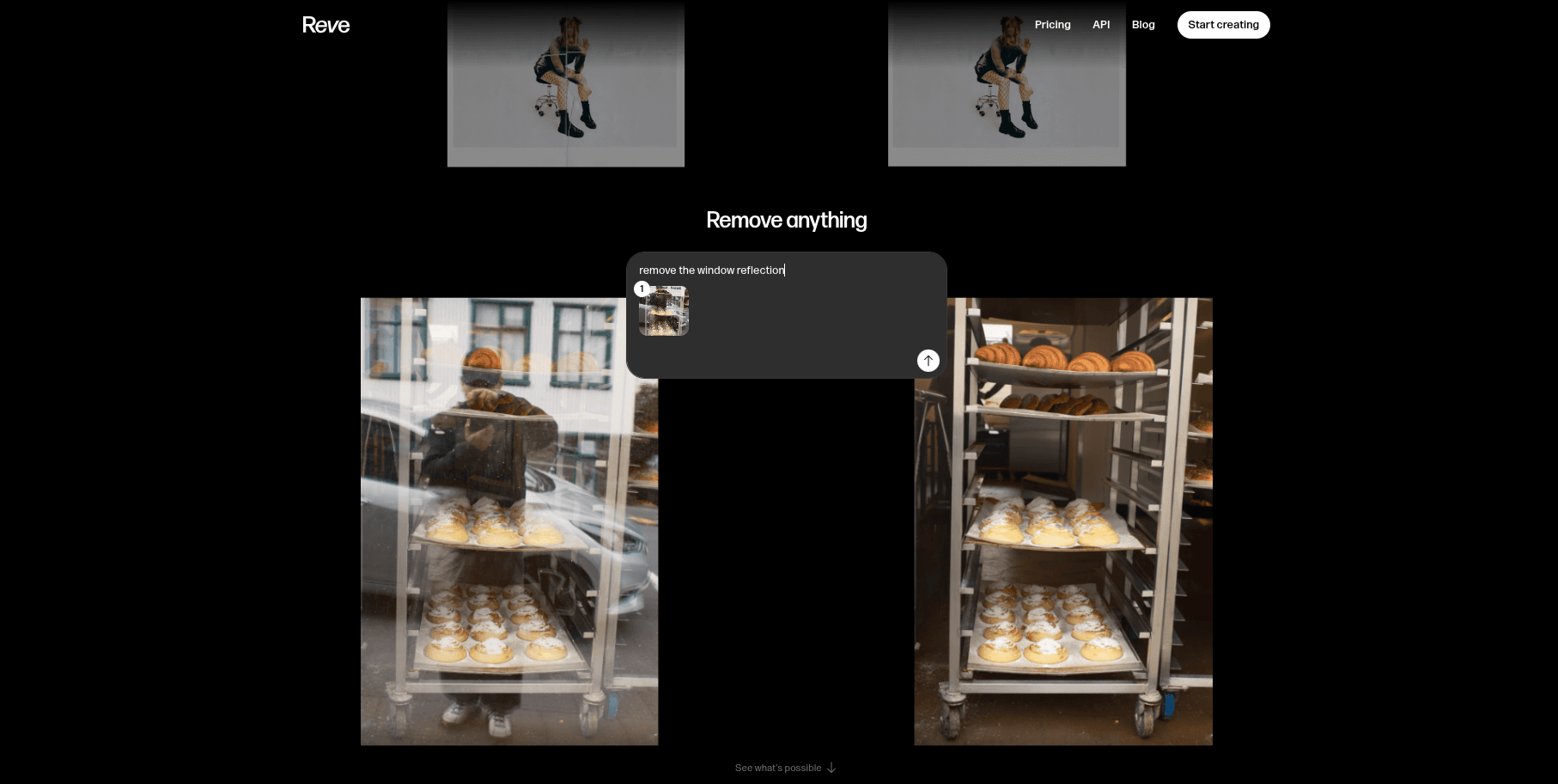
Launched March 2025, immediately claimed #1 on Artificial Analysis's Image Arena with an ELO score of 1167 — outperforming Midjourney v6.1, Nano Banana, and Seedream 4.0 in realism and text handling benchmarks. The pricing is aggressive: $5 for 500 images works out to $0.01 per image.
What's unusual: full commercial rights on all outputs, including free tier. Most platforms restrict commercial use to paid plans. Reve's 12B parameter hybrid model delivers prompt adherence that rivals much larger systems, with natural-language editing and image remixing (combine multiple images into new compositions).
For budget-conscious creators who still need quality, it's the value play without quality compromise.
Key features: 12B parameter hybrid model. Full commercial rights on all images, including free tier. Natural language editing. Image remixing (combine multiple images). Enhanced text rendering. Strong prompt adherence.
Best for: Budget-conscious creators who still need quality. Commercial projects on a tight budget.
API: Available via providers ( AIML API, Replicate).
Open Source / Self-Hosted
Run models on your own hardware. Higher setup cost, lower per-image cost at scale. Full control over the pipeline.
FLUX (Black Forest Labs)
bfl.ai
The community favorite for self-hosting. Black Forest Labs publishes open-weight models alongside commercial offerings — their philosophy of "sustainable open innovation" drives adoption among developers who want control without vendor lock-in.
FLUX.2's standout capability: multi-reference support combining up to 10 images simultaneously while maintaining character, product, and style consistency. The architecture pairs a Mistral-3 24B vision-language model with a rectified flow transformer — it understands real-world physics, lighting, perspective, and material properties rather than just pattern matching.
Text and typography mastery makes complex infographics, memes, and UI mockups with legible fine text work reliably. The community has developed FP8 quantizations that reduce VRAM requirements by 40% while improving performance — running state-of-the-art generation on consumer hardware.
Models: Schnell (speed), Dev (balanced, most popular), Pro (commercial license), Kontext (editing/context-aware).
Hardware requirements: Full models need 16-24GB VRAM. Quantized versions (GGUF) run on 6-8GB, with Q2 quantization possible on 4GB. RAM: 16GB minimum, 32GB recommended.
Key features: ComfyUI as the primary interface. Multi-reference support (up to 10 images). ControlNet support via Flux Tools (Canny, Depth) and XLabs collections. LoRA training through FluxGym, Replicate trainer, or fal.ai. Top-tier prompt understanding. 32K token context on Pro model.
Best for: Developers who want maximum control. High-volume generation where per-image cost matters. Custom model training.
API: REST API. MCP. Temporary URLs (10 min expiration). Inpainting, outpainting, multi-reference editing.
Stable Diffusion 3.5
stability.ai
The foundation model that democratized AI image generation. What Stable Diffusion 3.5 brings: a Multimodal Diffusion Transformer (MMDiT) architecture that fundamentally improves how the model understands relationships between text and images. Legible, contextually integrated text — the long-standing challenge — now works.
Three variants for different hardware realities: Large (8.1B params, professional-grade), Large Turbo (4-step fast generation), and Medium (runs on 9.9GB VRAM — standard consumer GPUs). The permissive Community License enables commercial and research applications without enterprise agreements.
The ecosystem advantage is unmatched: thousands of fine-tunes, LoRAs, and ControlNets built by the community. DreamBooth training works with as few as five images. For developers wanting to customize rather than use off-the-shelf, no other model has this depth of community tooling.
Models: Large (8.1B params), Turbo (4-step fast generation), Medium (9.9GB VRAM requirement).
Hosted options: DreamStudio (official), Stability AI API, plus dozens of third-party UIs.
Key features: MMDiT architecture for superior prompt adherence. Diverse style range (3D, photography, painting, line art). Massive ecosystem of fine-tunes, LoRAs, and ControlNets. Query-Key Normalization for simplified fine-tuning. Runs on consumer hardware.
Best for: Local deployment. Custom pipeline development. Access to the largest model ecosystem.
API: REST API. SDK: Python, Go. CLI via Python SDK. Upscaling, inpainting, outpainting, background removal.
Civitai
civitai.com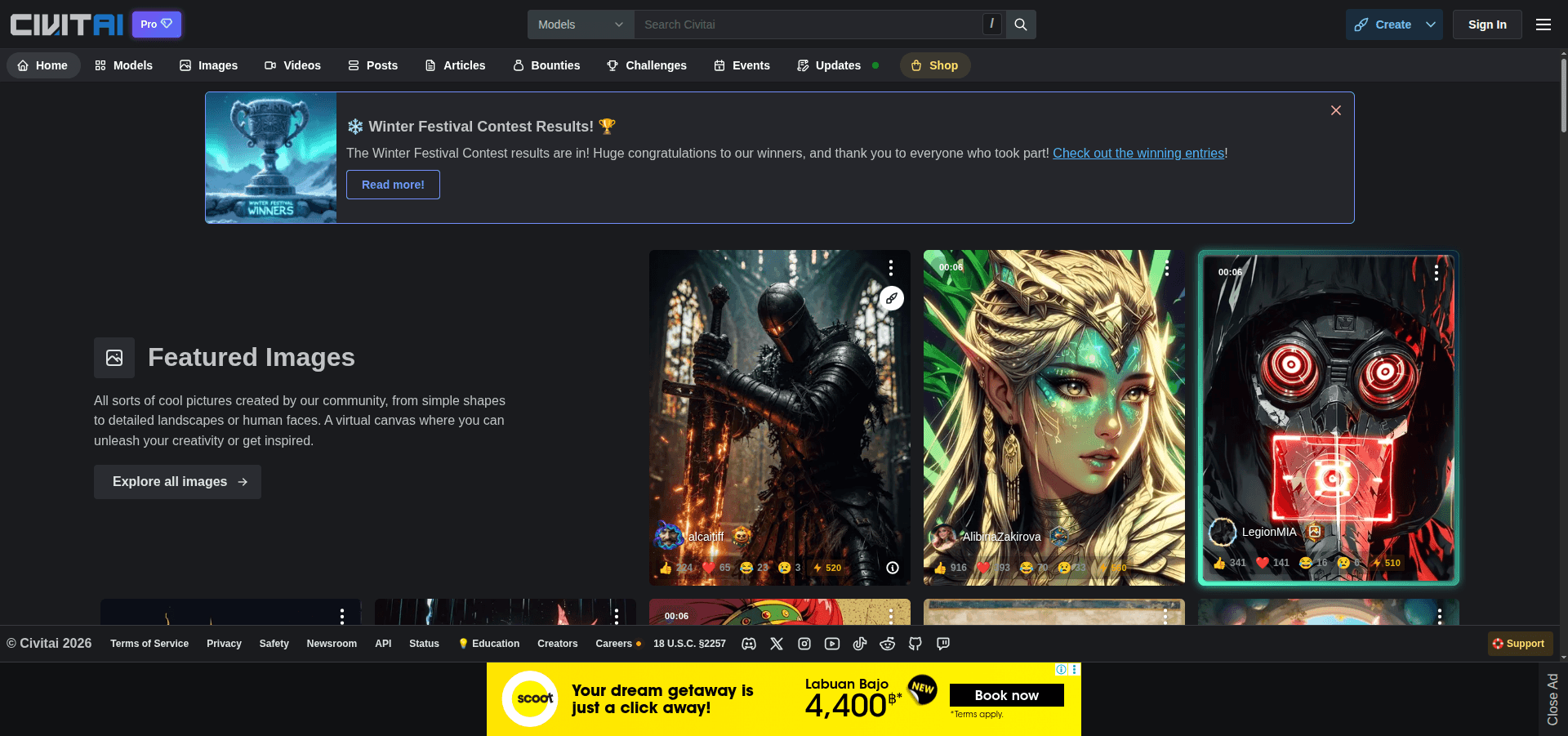
Not a model — a marketplace and community. Tens of thousands of checkpoints, fine-tunes, and LoRAs for SD and FLUX families. What makes it essential: finding niche styles that don't exist in base models. A specific anime aesthetic, a particular photography style, a character concept — someone has probably trained a model for it.
The platform evolved into an all-in-one hub in 2025: on-site image and video generation (including Vidu, Wan 2.1, Hunyuan), integrated LoRA trainer (including video LoRA), and creator monetization through the revised Creator Program. Usage Control lets model creators restrict how their work is used.
Important 2025 context
Key features: Browse tens of thousands of checkpoints: SD families, FLUX variants, video models. Generate directly on-site: txt2img, img2img, ControlNet. Built-in LoRA trainer (including video). Community features: Bounties, Creator Program for monetization. Per-model licensing with Usage Control.
Best for: Finding niche styles. Community fine-tunes. Exploring what's possible before training your own.
API: REST API. CDN hosting (permanent URLs).
API-First Platforms
Midjourney has no official API. Third-party wrappers exist but violate ToS and risk account bans. These platforms provide legitimate programmatic access to image generation.
Key considerations when choosing: pricing model (per-image vs GPU-time), SDK support, model selection, latency.
Replicate
replicate.com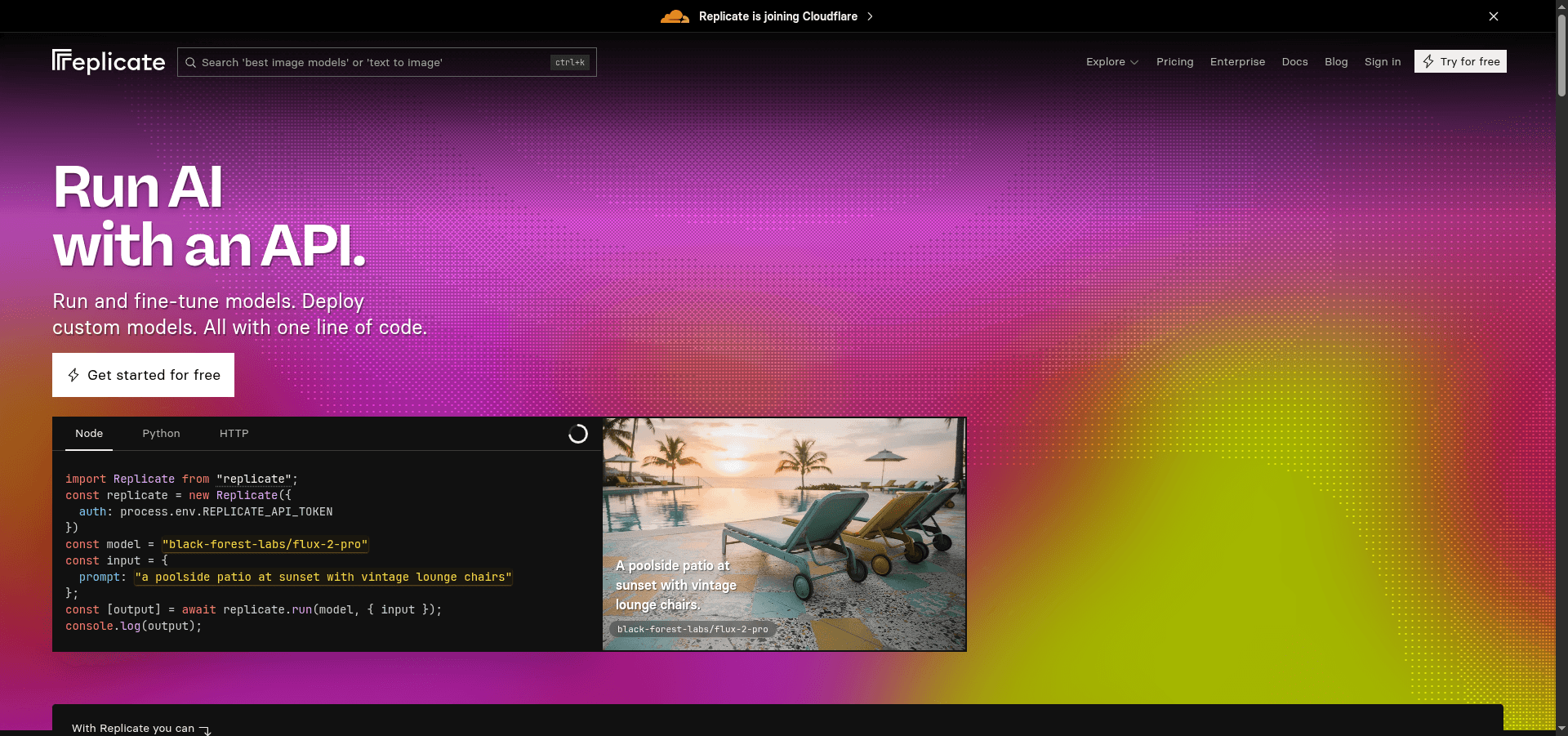
The model marketplace for developers. 50,000+ production-ready models spanning image generation, transcription, and beyond. The appeal: run any model with one line of code, no GPU configuration or backend setup required.
Replicate's Cog tool lets you package and deploy custom models as production APIs with automatic scaling and versioning. The zero-scale economics mean you pay only when generating — no idle capacity costs. Fine-tuning with custom data creates on-brand outputs without infrastructure expertise.
November 2025 milestone
Key features: 50,000+ production-ready models via Official Models program. Cog tool for deploying custom models. Zero-scale economics — pay only when generating. Fine-tuning support. NVIDIA H100 GPU support for demanding workloads. Cloudflare acquisition expands reach.
Gotcha: Stripe payment issues reported in some regions.
Best for: Model variety. Serverless deployment. Teams that need zero-scale economics.
API: REST API. SDK: Python, Node.js, Swift, Go. MCP. CDN hosting.
fal.ai
fal.ai
Speed-focused platform. 600+ models including FLUX.2, often with day-zero access to new releases. The technical edge: inference engine up to 10x faster than traditional deployments through 100+ custom CUDA kernels optimized for diffusion transformers.
For developers, zero DevOps friction matters: no GPU configuration, no cold starts, no autoscaler setup. The TypeScript SDK (@fal-ai/client) enables rapid prototyping with minimal boilerplate. The platform scales from prototypes to 100M+ daily inference calls with 99.99% uptime.
fal's FLUX.2 [dev] Turbo is 6x more efficient than the full-weight model while being 3-10x cheaper than comparable APIs. December 2025 funding: $140M Series D at $4.5B valuation from Sequoia, NVIDIA, Kleiner Perkins, and a16z — validation of the speed-first approach.
Users: 2M+ developers.
Key features: 10x faster inference via custom CUDA kernels. Sub-second generation for Schnell. Day-zero access to new model releases. No cold starts. Unified API across 600+ models. Real-time video generation with temporal consistency.
Best for: Speed-critical applications. TypeScript developers. Teams that want the latest models first.
API: REST API, WebSocket. SDK: TypeScript, Python, Swift, Java, Kotlin, Dart. MCP. CLI. Style transfer, img2img.
Banatie
banatie.app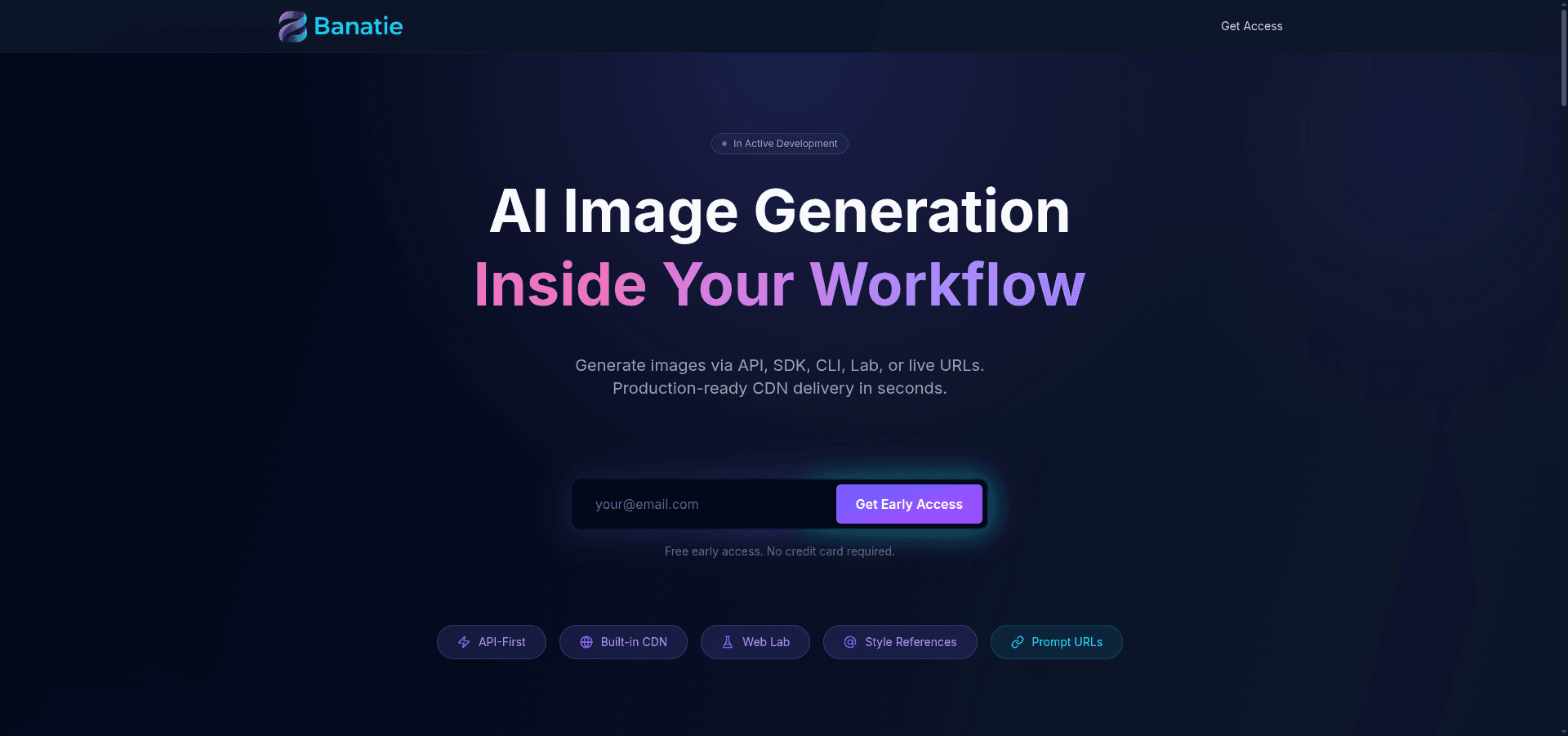
Developer-native image generation built for AI coding workflows.
The problem Banatie solves: generating images means leaving your IDE, switching to an external tool, downloading files, organizing them manually. This context-switching breaks flow, especially when you're deep in a Claude Code or Cursor session.
Banatie integrates directly into your development environment. MCP Server connects to Claude Code, Cursor, and other MCP-compatible tools — generate images without leaving your editor. REST API for standard HTTP access. Prompt URLs let you generate images via URL parameters for on-demand generation. SDK and CLI tools handle automation in build pipelines.
The platform enhances your prompts automatically, delivers images through a built-in CDN globally, and organizes everything by project. Use @name references to maintain visual consistency across project images — reference a character or style once, use it everywhere.
Where other API platforms focus on model variety (Replicate), speed (fal.ai), or cost (Runware), Banatie focuses on workflow. MCP integration, built-in CDN, and Prompt URLs are unique to this platform.
Best for: Developers using AI coding tools who want image generation without leaving their editor.
API: REST API. Live URLs. CDN hosting (permanent URLs).
Runware
runware.ai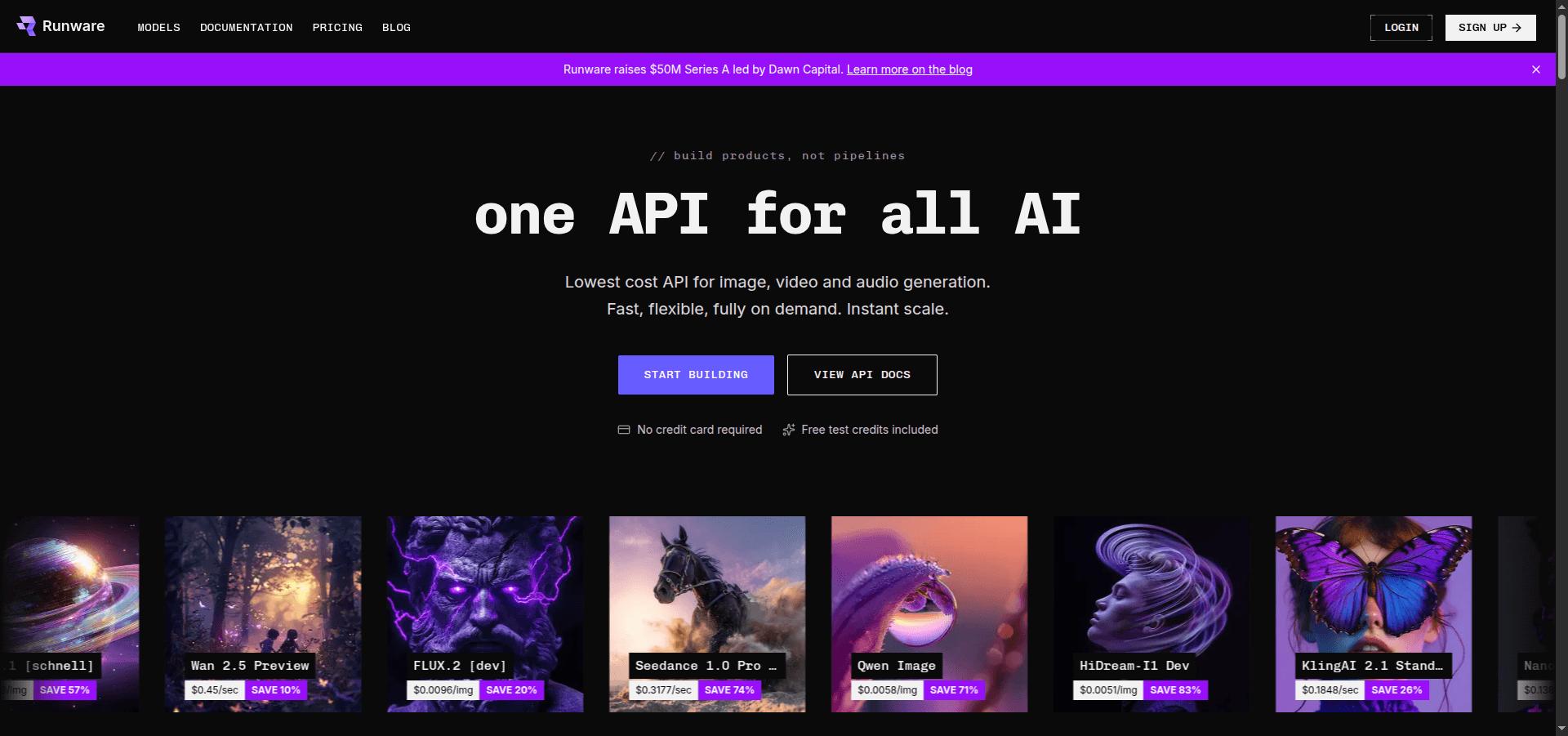
The cost leader. Their Sonic Inference Engine runs on AI-native hardware (custom servers, storage, networking, cooling) achieving near-100% GPU utilization — effectively halving cost per generation compared to traditional data centers.
The numbers: $0.0006/image for FLUX Schnell — that's 1,666 images per dollar. Sub-second inference times. 0.1s LoRA cold starts. A unified API provides access to 300,000+ models including open-source options from Civitai.
The pricing model differs fundamentally from competitors: cost-per-image rather than compute-time billing. You pay for actual outputs regardless of processing overhead. Enterprise customers report $100,000+ monthly savings migrating from competitors.
Models: 300,000+ via unified API (SD, FLUX, Imagen).
Key features: Sonic Inference Engine on custom hardware. Sub-second inference. 0.1s LoRA cold starts. Per-image pricing (not compute-time). Zero-day access to new releases. Runs on renewable energy.
Best for: High-volume production. Cost-sensitive projects. Startups watching burn rate.
API: REST API, WebSocket. SDK: JavaScript, Python. Upscaling, inpainting, outpainting, background removal, vectorize.
Segmind
segmind.com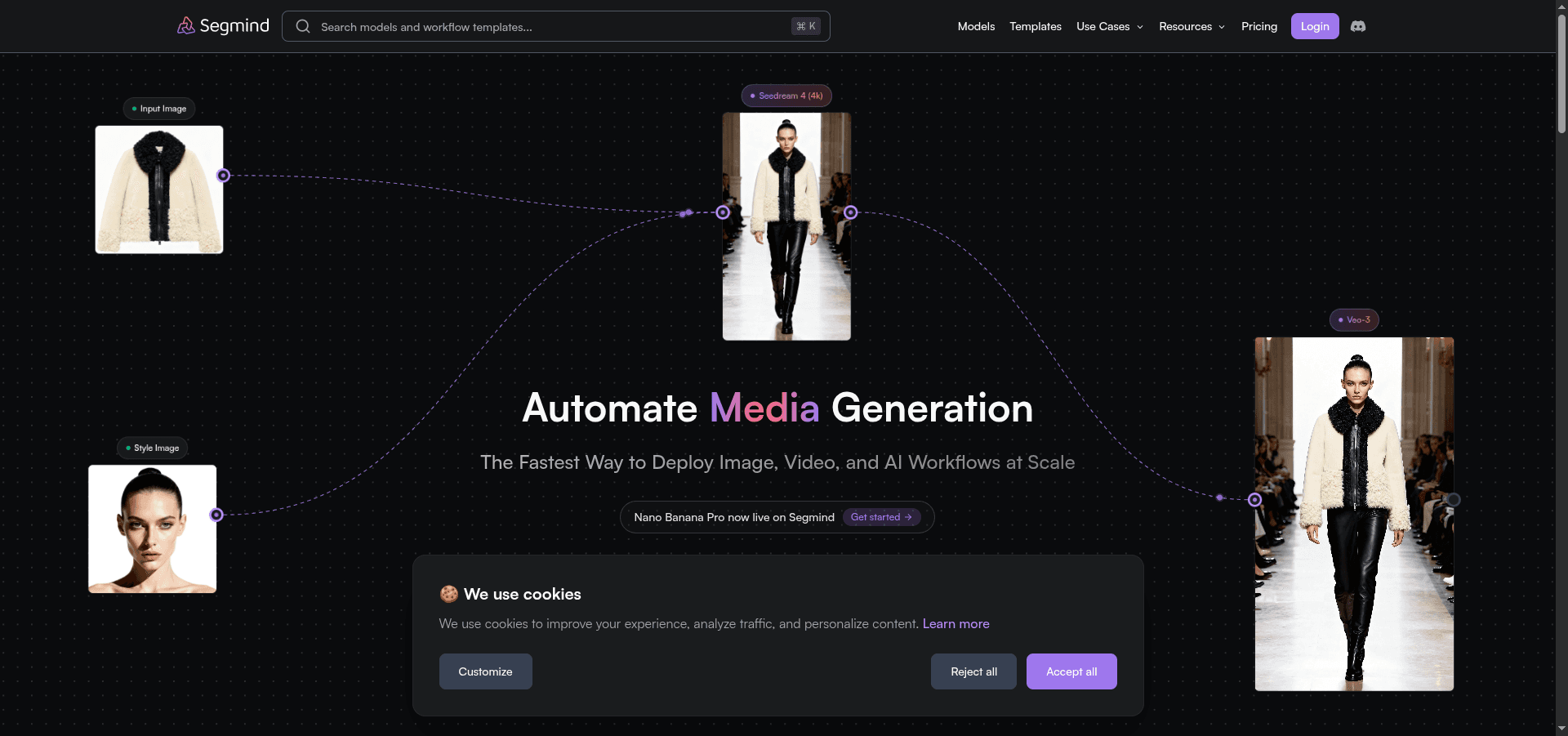
Workflow-focused platform. PixelFlow is the differentiator: a cloud-based drag-and-drop builder where you create generative AI pipelines visually, then convert them directly into production APIs. No code required to build complex multi-step workflows.
The parallel processing capability runs a single input through multiple models simultaneously — generate different variations using multiple SDXL checkpoints at once. Combine text, image, audio, and video generation in unified workflows: product descriptions → promotional images → accompanying text → video — all without switching tools.
500+ AI models accessible, per-second billing (~$0.002/s on A100), and 338+ pre-built templates covering AI sketch-to-3D, photo restoration, portrait video, product ads, and infographics.
Key features: PixelFlow visual workflow builder. Parallel processing through multiple models. Publish workflows as API endpoints. Multimodal AI integration (text, image, audio, video). 338+ pre-built templates. Fine-tuning support.
Best for: Complex generation pipelines. Teams building custom image processing workflows.
API: REST API. SDK: JavaScript. Image hosting (shareable URLs). Upscaling, inpainting, outpainting, background removal, segmentation.
Novita AI
novita.ai
Budget option with startup-friendly programs. The Agent Sandbox launched in 2025 delivers millisecond-level startup times for AI agent workloads — optimized for high-concurrency tasks where traditional cold starts kill performance.
10,000+ image models with rapid integration of trending open-source releases (DeepSeek, Qwen, Llama 3) means access to cutting-edge tools without corporate release cycle delays. The dual-service model combines ready-to-use inference APIs with GPU cloud infrastructure for custom development.
The Startup Program offers up to $10,000 in credits — meaningful runway for early-stage teams validating AI-powered features.
Models: 10,000+ image models plus LLMs, video, audio.
Key features: Agent Sandbox with millisecond startup times. Serverless GPU endpoints. Dedicated Endpoints for custom models and LoRA adapters. Function calling and structured outputs across LLMs. Startup Program with $10k credits.
Best for: Early-stage startups. Budget-constrained projects. High-concurrency agent workflows.
API: REST API. SDK: Python. Upscaling, inpainting, outpainting, background removal, ControlNet.
Together AI
together.ai
Unified AI platform covering text, image, and video generation. The strategic advantage: OpenAI-compatible endpoints make it a drop-in replacement for teams migrating from proprietary APIs. Familiar SDK format, minimal code changes.
Inference runs up to 4x faster than traditional deployments through speculative decoding, quantization, and FP8 kernels. Browser-based fine-tuning launched in 2025 — customize models with your own data without Python SDK installation. The data preprocessing engine improved by up to 32% for large-scale training.
200+ open-source models across text, code, image, and multimodal categories. Pay-as-you-go with no minimums enables experimentation; 99.9% SLA availability handles production workloads.
Models: 200+ (FLUX.2, SD3, Imagen, SeeDream, plus text and code models).
Key features: OpenAI-compatible endpoints for easy migration. 4x faster inference. Browser-based fine-tuning without SDK. Direct preference optimization (DPO) support. Integration with Hugging Face Hub. 99.9% SLA.
Best for: Teams standardized on OpenAI SDK. Projects needing text + image + video from one provider. Easy migration from proprietary APIs.
API: REST API (OpenAI-compatible). SDK: Python, TypeScript. CLI. CDN hosting.
Aggregators
One subscription, multiple models. Compare outputs side-by-side. Good for exploration and finding the right model for your use case.
Poe (Quora)
poe.com
100+ models through one interface, including FLUX-pro, GPT-Image, Imagen 3/4, DALL-E 3, Gemini. The fundamental advantage: compare outputs from different models within a single conversation without managing separate subscriptions.
What sets Poe apart from simple aggregators: group chats supporting up to 200 users across 200+ AI models simultaneously. Families planning trips with specialized search models, creative teams brainstorming with various image generators — collaborative AI workflows that don't exist elsewhere.
Custom bot creation lets you build chatbots using prompts and existing models as a base. The July 2025 API release uses OpenAI-compatible format for developer integration. Real-time chat sync across devices maintains context when switching from desktop to mobile.
API: REST API (OpenAI-compatible format).
Key features: 100+ models including major providers. Multi-model comparison in one chat. Group chats for 200 users across 200+ models. Custom bot creation. App Creator for building simple tools. Real-time cross-device sync.
Best for: Exploring different models before committing. One subscription for access to everything. Collaborative multi-model workflows.
Krea.ai
krea.ai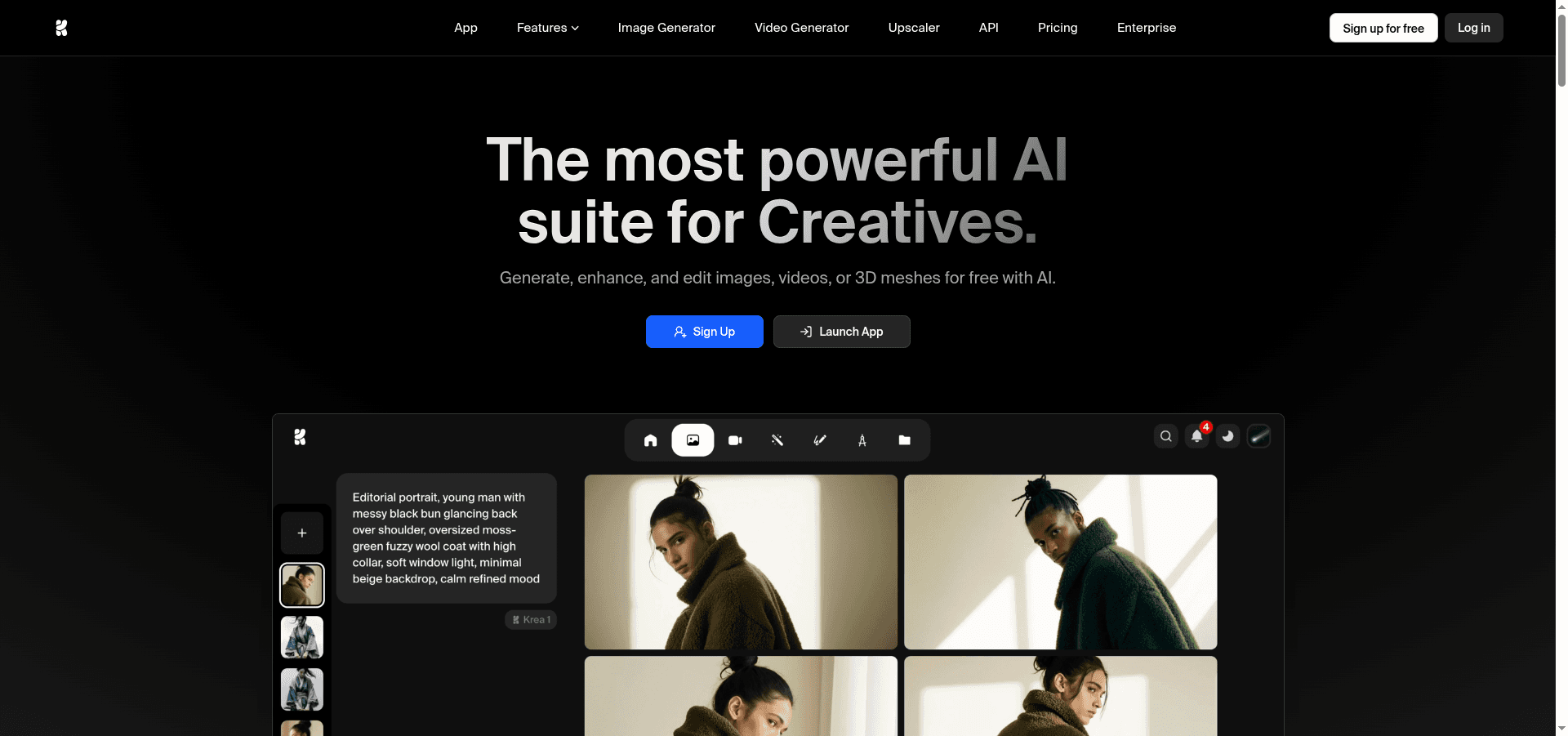
Real-time generation leader. The core innovation: draw on the canvas and watch AI respond in under 50ms. This transforms image generation from "prompt-wait-revise" into active creative sculpting. You see results instantly, making iteration feel like playing an instrument rather than operating a vending machine.
The AI Strength slider is critical — balance how closely AI follows your sketch versus how much creative freedom it exercises. Designers rapidly iterate on logos, layouts, prototypes by painting primitives and seeing instant results. Concept artists convert rough 3D models into fully textured concept art in seconds.
Beyond real-time generation: in/out-painting, style transfer, and an Enhancer upscaling to 22K resolution. Krea also functions as an image-to-video hub, dispatching stills to Runway, Luma, and Hailuo for seamless storyboarding from static visuals to motion.
Models: Flux, Veo 3, Kling, Runway, 20+ total.
Key features: Real-time canvas — draw and see AI generation in <50ms. AI Strength slider for control balance. 22K resolution upscaling. In/out-painting and style transfer. AI Patterns for tileable textures. Real-time video generation. Image-to-video hub integration.
Best for: Concept artists. Interactive co-creation. Anyone who thinks in sketches rather than prompts.
API: REST API. Upscaling, style transfer, enhance.
Freepik AI
freepik.com/ai
All-in-one creative platform combining stock assets, AI generation, and editing. The Mystic model delivers exceptional photorealism with pixel-perfect text rendering — capabilities where Midjourney and DALL-E 3 struggle. National Geographic-level composition with skin textures and individual hair strands that exceed expectations for AI-generated content.
Mystic integrates finetunes of Stable Diffusion, Flux, and Magnific.ai technology for 2K default resolution without upscaling. Complex prompts complete in under a minute. For marketers creating social media graphics, promotional materials, and branded content, the text accuracy eliminates post-production fixes.
The ecosystem integration matters: generate with Mystic, refine with Retouch (selective editing), expand compositions, create variations — all within one interface. No bouncing between Photoshop, design tools, and image generators.
Models: Mystic (proprietary, fine-tuned on Flux/SD/Magnific), plus Flux and Ideogram.
Key features: Mystic model with 2K default resolution. Superior text rendering vs competitors. AI Video via Veo. Sketch-to-Image. Custom Characters. Integrated Retouch, Expand, Reimagine tools. Multiple model modes for different styles.
Best for: Marketing teams. All-in-one creative workflow. Text-heavy marketing materials.
API: REST API. Multiple rendering engines. Style and structure reference images. Character system. LoRA styles.
FAQ
Is there an AI better than Midjourney?
Depends on what you need. For text rendering: Ideogram, Recraft, or GPT-4o. For API access: fal.ai, Replicate, or Banatie. For free usage: Leonardo AI, Gemini, or Reve. For commercial safety: Adobe Firefly. For vectors: Recraft. Midjourney excels at artistic quality but lacks API access and has no free tier.
What is similar to Midjourney but free?
Leonardo AI gives you 150 tokens daily. Gemini offers unlimited generation in the app (with watermark). Reve provides 100 credits plus 20 per day. Ideogram and Poe both have free tiers. For truly unlimited free generation, self-host FLUX with ComfyUI — requires your own GPU.
Which AI image generator has no restrictions?
Most services have content policies. Self-hosted options (FLUX, Stable Diffusion via Civitai) offer the most freedom. Civitai hosts community models with varied restrictions. Note that "no restrictions" often means NSFW content — check individual model licenses for commercial use.
Is Midjourney better than Stable Diffusion?
Different tools for different needs. Midjourney: easier to use, consistent artistic style, no setup. Stable Diffusion: free, fully customizable, self-hostable, massive model ecosystem. For developers wanting programmatic access, SD or FLUX via API gives more control. For artists wanting quality-per-prompt, Midjourney remains hard to beat.
Does Midjourney have an API?
No official API. Third-party wrappers exist but violate Midjourney's Terms of Service and risk account bans. For legitimate programmatic image generation, use Replicate, fal.ai, Runware, Together AI, or Banatie. These platforms provide similar quality models (especially FLUX) with proper API access.
Conclusion
No single "best" Midjourney alternative exists — it depends on your specific needs.
Quick decision guide:
- Want a UI? → Leonardo AI, Reve, or Adobe Firefly
- Need API access? → fal.ai, Runware, or Banatie
- Prefer self-hosting? → FLUX with ComfyUI
- Want to explore models? → Poe or Krea
Developer-native image generation
For developers working with AI coding tools, Banatie integrates directly into your workflow — generate images without leaving your editor.
Get API Access